Showing posts with label CN1. Show all posts

Tuesday, May 19, 2009

Darwin la teoria de la evolucion


www.Tu.tv


undefined

Tuesday, April 14, 2009

Hurricanes (unit 3)


If this type of storm forms in the western Pacific Ocean, it is called a typhoon.
Hurricanes often travel from the ocean to the coast and on to land, where the wind, rain, and huge waves can cause extensive destruction.
Generally, when a hurricane moves over land (or over cold ocean waters) the storm begins to weaken and quickly dies down because the storm is fueled by warm water.
On average, there are about 100 tropical cyclones worldwide each year; 12 of these form in the Atlantic Ocean, 15 form in the eastern Pacfic Ocean and the rest are in other areas.
Hurricane season is the time when most Atlantic Ocean hurricanes occur; it is from June 1 until November 30. In the eastern Pacific Ocean, hurricane season is from May 15 until November 30.

The weather symbol for a hurricane is:


The marine flags that alert boaters to a hurricane are two square red banners, each with a black square in the middle:

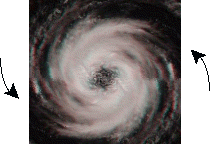
A hurricane is a powerful, rotating storm that forms over warm oceans near the Equator. Another name for a hurricane is a tropical cyclone. Hurricanes have strong, rotating winds (at least 74 miles per hour or 119 kilometers per hour), a huge amount of rain, low air pressure, thunder and lightning. The cyclonic winds of a hurricane rotate in a counterclockwise direction around a central, calm eye.
To know more about hurricanes click here:

Tuesday, March 17, 2009

Unit 1: links related to the Solar System

Here you are a list of links realated to the solar system. They are very interesting! We invite you to visit them!


http://www.kidsastronomy.com/earth.htm

http://starchild.gsfc.nasa.gov/docs/StarChild/solar_system_level1/sun.html

http://www.windows.ucar.edu/tour/link=/our_solar_system/solar_system.html

http://www.windows.ucar.edu/tour/link=/our_solar_system/solar_system_1.html

Tuesday, December 9, 2008

Tuesday, November 18, 2008

CN1 Unit 8 Water

Let's do some fun experiments with water

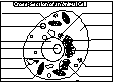
Parts of a cell. Unit 5

Copy this drawing of a cell and write its parts.


Do you want to see the answers? Then, click here
If you want to browse in this page you´ll learn a lot about cells: enchantedlearning

CN1 Unit 5 The cell

All you need to know about the cell

Friday, May 9, 2008

Desert Habitats.Unit 1 CN, Unit 4 CS

Some desert animals from around the world:
Haz una lista de todos los animales
Haz clic en la imagen para encontrarlos

Unit 4. Botany and Paleobotany Dictionary


Click on the picture to find the terms you need.


Friday, April 25, 2008

Unit 3 .LIGHT AND SOUND

http://www.enchantedlearning.com/subjects/anatomy/ear/label/labelanswers.shtml

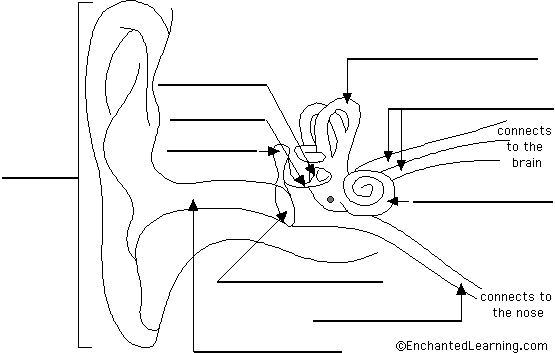
Label the Ear Anatomy Diagram


Human Anatomy
Sound is collected by the pinna (the visible part of the ear) and directed through the outer ear canal. The sound makes the eardrum vibrate, which in turn causes a series of three tiny bones (the hammer, the anvil, and the stirrup) in the middle ear to vibrate. The vibration is transferred to the snail-shaped cochlea in the inner ear; the cochlea is lined with sensitive hairs which trigger the generation of nerve signals that are sent to brain.
Read the definitions below, then label the ear anatomy diagram.

anvil - (also called the incus) a tiny bone that passes vibrations from the hammer to the stirrup.
cochlea - a spiral-shaped, fluid-filled inner ear structure; it is lined with cilia (tiny hairs) that move when vibrated and cause a nerve impulse to form.
eardrum - (also called the tympanic membrane) a thin membrane that vibrates when sound waves reach it.
Eustachian tube - a tube that connects the middle ear to the back of the nose; it equalizes the pressure between the middle ear and the air outside. When you "pop" your ears as you change altitude (going up a mountain or in an airplane), you are equalizing the air pressure in your middle ear.
hammer - (also called the malleus) a tiny bone that passes vibrations from the eardrum to the anvil.

nerves - these carry electro-chemical signals from the inner ear (the cochlea) to the brain.
outer ear canal - the tube through which sound travels to the eardrum.
pinna - (also called the auricle) the visible part of the outer ear. It collects sound and directs it into the outer ear canal
semicircular canals - three loops of fluid-filled tubes that are attached to the cochlea in the inner ear. They help us maintain our sense of balance.
stirrup - (also called the stapes) a tiny, U-shaped bone that passes vibrations from the stirrup to the cochlea. This is the smallest bone in the human body (it is 0.25 to 0.33 cm long).


To find the answers of this exercise click on: answers


Friday, April 18, 2008

Unit 2. Vertebrates

Maths (cambio de medidas) Natural Sciences (características de los vertebrados) and English (texto descriptivo)

http://msnucleus.org/membership/html/k-6/lc/organ/1/lco1_4a.htmlUnit 2: Vertebrates


Here you have information about some animals.
PENGUIN - This is an emperor penguin the largest and most colorful of all the penguins. The emperor penguin which stands nearly four feet high, is the giant of all present-day penguins. The female lays her egg and then abandons her egg to her partner. The male incubates a single egg by carrying it on its large feet. The female returns after the egg hatches and takes care of the chick. A penguin's body is streamlined and this helps it to swim with remarkable skill. Penguins hunt while swimming, catching fish and other small sea creatures. They can obtain a height of 1.35 m (4 ft) and weight up to 22 to 45 kg (50-100 lbs).
BLUE WHALE - The blue whale is the largest and heaviest animal of all time. It can weight up to 508,000 lbs and reach a length of 110 feet. It is a strong mammal that can travel at 25 hours per hour. At birth it can weight 6,600 lbs and be 7 meters (25 feet) in length. The blue whale is a filter feeder, meaning that it has "baleen" filters in its mouth where plankton (small floating organisms) are trapped. The sound of a blue whale is awesome, a high pitched sound can be heard 530 miles away.
SHARK - You can use this puppet to describe the Great White Shark or the Sand Shark, depending on whether you want to describe a monster or benign member of a very primitive fish family. The sand shark is found in the Atlantic Ocean. This shark is not normally dangerous to humans. It eats fish and mollusca. The babies are born from the mother. They can weigh up to 170 kg or 375 lbs and can be up to 3.2 m or 10.5 feet in length. The Great White Shark is a very large fish with a terrifying mouth. These saw-toothed edged teeth are as sharp as razor blades. The shark inhabits all the world's seas. The Great White tends to attack everything that looks like food. It eats absolutely everything and the stomach of many Great Whites include dustbins, tins of jam, and thousands of metal objects. The adult length is up to 10 meters or 33 feet.
STINGRAY - The rays are primitive fish related to sharks. Their skeletons are made of cartilage, not bone. There are about 90 species of stingrays which range in size from one to seven feet across. They live on the bottom of the sea floor.
HERMIT CRAB - Hermits crabs are related to crabs and lobsters. Most live in tidal areas or deeper in the ocean. A few are even land dwellers. A Hermit crab has two large pincers and two pairs of walking legs. When threatened, it pulls entirely into its shell.
SCALLOP - There are over 300 species of scallop that live throughout the marine world. The scallop can "swim" in the water, by using a propelling motion as they open and close their shells. Scallops have tiny bright blue eyes all along the edge of the shells. These eyes are highly sensitive to light and dark.
DUNGENESS CRAB - The Dungeness crab ranges from Alaska to California. It lives in sandy areas from the low tide line to 300 feet deep. The dungeness crab can live eight years and be 10 inches across. To grow the crab sheds its shell or molts, before the new shell hardens. The Dungeness crab has 10 legs, the front pair are modified into piners with which it catches small fish and shellfish.
OCTOPUS - There are over 150 species of octopus which belong to the mollusk family. They are found throughout the world’s oceans, most commonly in warm seas.Octopuses range in size from two inches to a giant 32 feet across the arms of the Pacific species. Octopuses are masters of camouflage. They can change color, shape and skin texture. The octopus’ well-developed eyes enable it to see all around itself.
DOLPHIN - This is a mammal, although there is a fish by the same name. They live in the open ocean, but visit the coastal areas as well. They tend to live in warmer waters.
LOBSTER - Lobsters belong to the invertebrates grouping of animals. They are related to crabs and other jointed critters, like insects. They have two well developed pinchers which they use to eat and defend themselves.
The following vertebrates listed below may be included in your set. Remember, if you have puppets, you may want to include them.

Friday, April 11, 2008

Unit1 (CN) Unit 7 (IN)Phoca, the Traveling Harbor Seal

Read, Phoca, the Traveling Harbor Seal. It is about a harbor seal (scientific name, Phoca vitulina) that lives in the San Francisco Bay, and was born in Mowry Slough. After reading the story discuss the vertebrates and invertebrates in the story. Remember that the vertebrate (harbor seal) ate many invertebrates (i.e octopus).